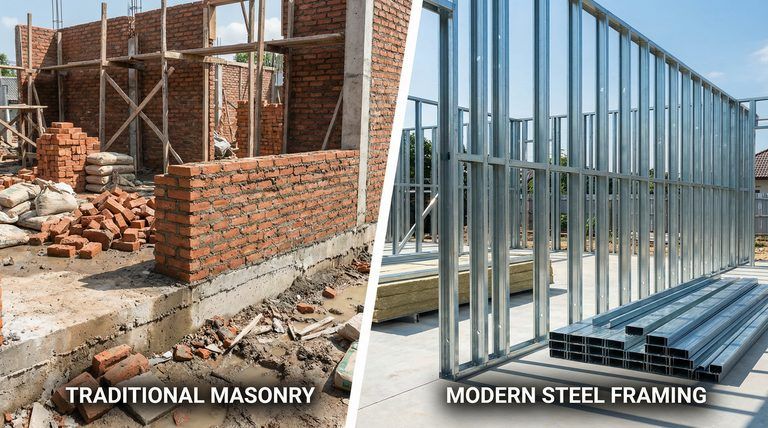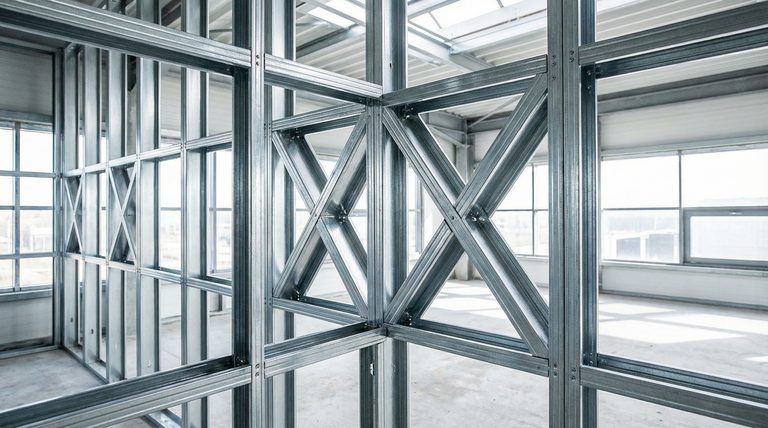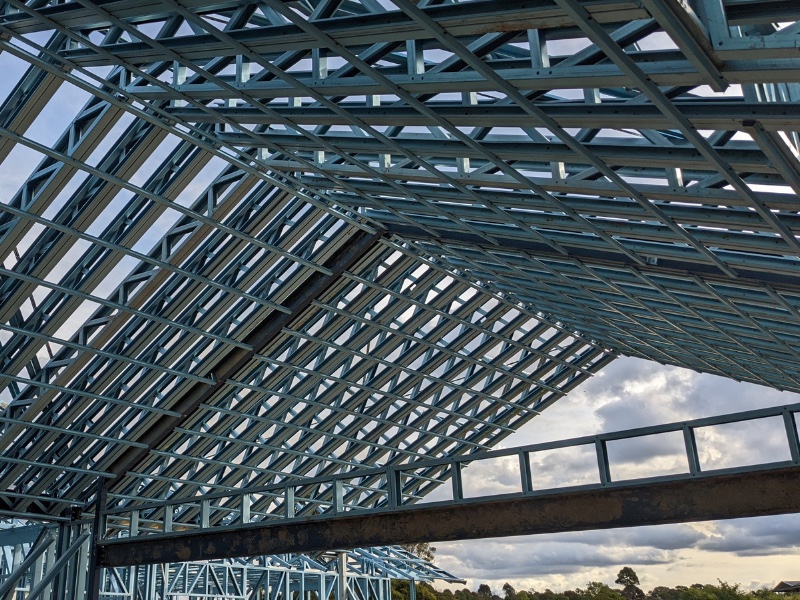
Cold-formed steel (CFS) is today one of the most widespread construction materials worldwide and the backbone of LGSF technology. In many countries, it has already replaced wood as the standard for roof trusses — from family houses through residential buildings and hotels to multi-storey structures. The reason is simple: light gauge steel addresses exactly the problems that persist with wood.
Why choose light gauge steel over wood?
Wooden roof structures have their weaknesses — moisture, rot, mold, wood-destroying insects, shrinkage, and warping. Light Gauge Steel Framing (LGSF) trusses do not have these concerns:
- Durability — does not rot, mold, or attract pests or wood-destroying insects. No chemical treatment required.
- Non-combustibility — fire reaction class A1. Non-combustible and does not spread flames.
- Strength with low weight — high load-bearing capacity allows spanning large distances without unnecessarily massive elements. The light structure facilitates handling, assembly, and reduces the load on supporting structures.
- Sustainability — light gauge steel is 100% recyclable without quality loss and its properties do not change over time.
Key fact: Light gauge steel profiles are manufactured on a CNC line with an accuracy of ±1 mm — significantly more precise than manually processed wood. The result is precise fitting of components, minimal rework, and minimal waste.
Indicative comparison of light gauge steel (LGSF) and traditional wooden roofing.
Can LGSF handle any roof shape?
Trusses are designed in software and manufactured automatically with millimeter precision. Shrinkage, warping, and supply uncertainties are eliminated. Light gauge steel can also handle any roof shape — gable, hip, shed, mansard roofs as well as complex elements such as valleys, ridges, corners, and dormers. This opens up possibilities for attics, photovoltaics, or rainwater drainage.
What types of LGSF trusses exist?
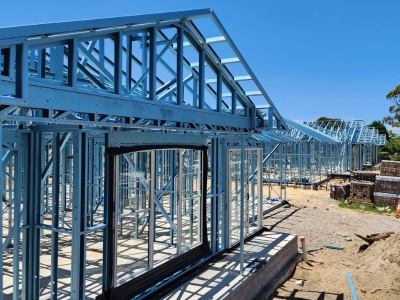
Two basic configurations are used in practice. Back-to-back trusses are designed for larger spans and often require less material. Inline trusses are easy to manufacture and assemble — they fit on walls and do not require temporary bracing during installation. Both types are produced on the same production line.
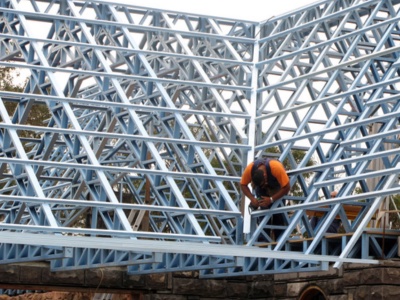
Safety: Light gauge steel has a fire reaction class of A1 — non-combustible and does not spread flames. Unlike wood, even an electrical short circuit will not ignite a light gauge steel frame.
Can I get LGSF trusses in the Czech Republic?
We offer the same technology in the Czech Republic. Skymax Living is the largest supplier of certified LGSF constructions in the Czech Republic and delivers throughout Europe. Roof trusses are manufactured from Light gauge galvanized steel S350GD (surface treatment Z275), designed according to Eurocodes (EN 1993-1-3), with an accuracy of ±1 mm — both pitched and monopitch, standardized stock items as well as custom atypical designs, ready for fast bolted assembly.
More from our offer: Roof Trusses · Flexi Panels · Modular construction.
Frequently Asked Questions
What are LGSF trusses (Light Gauge Steel Framing trusses)?
Truss systems made from thin-walled cold-formed Light gauge galvanized steel profiles, designed according to Eurocodes and manufactured on a CNC line with ±1 mm precision. They replace traditional timber roof structures.
Are LGSF trusses more expensive than wood?
Overall costs are comparable or lower — thanks to the lighter structure, faster assembly, less waste, and zero maintenance against rot and pests.
Do LGSF trusses burn?
No. Light gauge steel has fire reaction class A1 (non-combustible) and does not spread flames, unlike wood.
Can LGSF trusses handle atypical roof shapes?
Yes — gable, hip, shed, mansard roofs as well as dormers and large spans. The shape is designed in software and manufactured precisely to measure.